

We are incredibly excited to share the inspiring contribution of young artist Sarah, who has generously donated her artwork to our hospital and psych unit. At just fifteen years old, Sarah is already making a significant impact in raising awareness about mental health in our community through her unique artistic expression.
Sarah’s piece, titled “Different Languages of Depression,” beautifully illustrates the complexity and varied experiences of mental health, using the imagery of layers of eyes to convey profound emotions. This artwork not only adds beauty to our space but also sparks important conversations about mental wellbeing.
In her own words, Sarah describes her work:
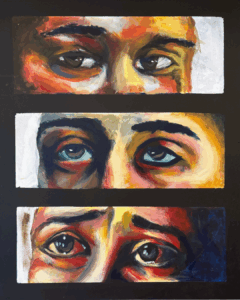
‘Different Languages of Depression’ by Sarah Wang
“Different Languages of Depression illustrates three sets of eyes on top of each other, displaying contrasting emotions visually. Eyes are the epicentre of emotion; what may be lost in the eyebrows, or the mouth often always shows up in the eyes. The bottom register shows visible distress. The middle register shows a dullness, with no apparent emotion attached to it. The upper register shows slight satisfaction, or euphoria, but the lifelessness however still present. This piece highlights the many different ways depression can be shown through facial expression. Depression is not universal, changing for everyone. It can express itself very apparently, through the bottom registers, with tears and furrowed eyebrows, through the middle register, through an empty exhaustion, or even the top register, wherein people mask their depression with squinted eyes and a smile. (3 eyes)
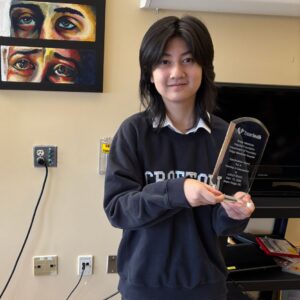
Sarah Wang
My name is Sarah. I’m fifteen years old and I am an aspiring psychologist. I’ve always been drawn to understanding the human mind, especially how it can connect to other media, such as art, allowing me to express my mental health and turn it into something tangible. I want to donate my work because I believe that presenting my art, a physical and visible representation of mental health, can make something as internal and often invisible as mental illness into a subject that’s accessible and easy to understand. Mental health is the foundation of how we think, feel, and act. Early treatment is especially important because it can prevent symptoms from becoming more serious and promote emotional resilience from a young age.”
Sarah’s dedication to understanding the human mind and expressing mental health through art is a message we wholeheartedly support. Her work encourages us all to recognize that mental health issues are complex and personal, affecting individuals in various ways.
As a community, let’s honor Sarah’s passion by fostering a supportive environment where mental health can be openly discussed. By raising awareness and encouraging early intervention, we can help promote emotional resilience and understanding among individuals of all ages.
Thank you, Sarah, for reminding us of the power of art in transforming conversations about mental health. May your journey inspire others to pursue their passions and contribute to a healthier, more compassionate community. Together, we can make a difference!